
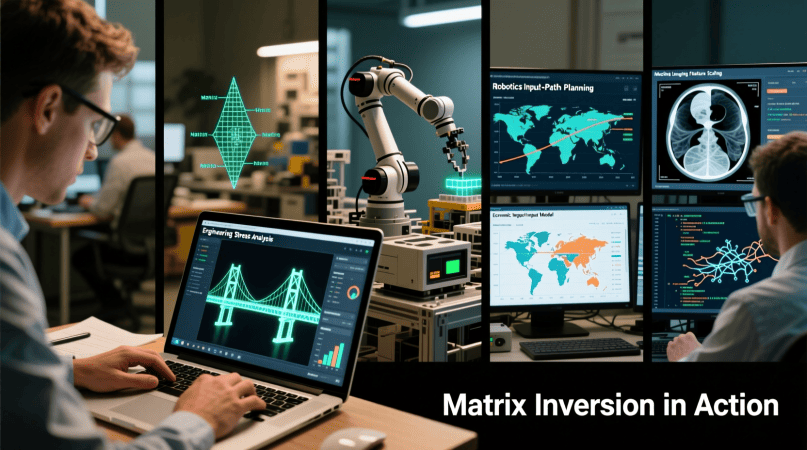
The matrix inverse isn’t just a math exercise — it’s a powerful tool used across science, engineering, and technology.
Whenever you need to reverse a transformation, solve systems of equations, or restore lost information, the inverse matrix is doing the work behind the scenes.
In this guide, we’ll explore five real-world examples of matrix inverses in action, showing how this single concept powers everything from robotics to machine learning.
1. Engineering: Solving Systems of Equations
One of the most common uses of the matrix inverse is solving linear systems — equations that describe relationships between forces, flows, or signals.
If you have: [ A X = B ]
Then you can find: [ X = A-1 B ]
This method is used in:
- Electrical engineering (solving circuit voltages)
- Mechanical engineering (analyzing stress and load distribution)
- Control systems (state feedback and stability analysis)
Example:
A structural engineer analyzing three forces acting on a bridge joint might represent them as: [ A = 2 & 1 & 0 \ 1 & 3 & 2 \ 0 & 2 & 4 \, B = 4 \ 5 \ 6 \ ]
Finding (X=A−1B) gives the internal reactions at each joint.
Try it instantly with the System of Equations Calculator.
Or learn how the inverse works in detail with our Inverse Matrix Calculator.
2. Computer Graphics: Undoing Transformations
In 3D graphics, matrices describe transformations like rotation, translation, and scaling.
To reverse a transformation — say, to return an object to its original position — we use the inverse transformation matrix.
Poriginal = A−1 Ptransformed
Example:
If a 3D model is rotated and scaled by matrix (A), applying (A-1) brings it back to its original coordinates.
This principle powers:
- Rendering engines (camera and light transformations)
- Virtual reality systems (tracking object motion)
- Robotics (coordinate frame transformations)
You can explore how this relates to geometric properties in Matrix Inverse vs Transpose.
3. Cryptography: Encoding and Decoding Messages
Matrix inverses are fundamental to Hill Cipher encryption, a classical cryptographic method that encodes messages as numbers.
How it works:
- Convert letters to numbers (A=0, B=1, …, Z=25).
- Multiply plaintext vector (P) by key matrix (K): [ C = K P ]
- To decrypt, multiply ciphertext (C) by the inverse of the key matrix: [ P=K−1C ]
Example: If K = 3 & 3 \ 2 & 5
and message = “HI”, the ciphertext depends on modular arithmetic with the inverse of (K).
This application shows how matrix inverses can secure or reveal hidden data — a concept used even in modern cryptography algorithms.
Learn more about determinant-based checks in Determinant of a Matrix.
4. Data Science: Linear Regression Models
In machine learning, the matrix inverse helps find the best-fit line for data points in linear regression.
The Normal Equation: 0 = X⊤ Xθ = X⊤y
Here:
- (X) = feature matrix
- (y) = output values
- (theta) = model coefficients
The inverse allows data scientists to compute model weights that minimize prediction error — without iterative training.
Example:
Predicting house prices using size, rooms, and location features uses the equation above to determine each feature’s contribution.
If (XT X) is not invertible, we use the pseudoinverse: 0 = X+y
You can explore this in Matrix Inverse vs Pseudoinverse.
5. Robotics and Control: Kinematic Transformations
In robotics, matrix inverses control motion and positioning.
Robots use Jacobian matrices to relate joint angles and end-effector positions.
To move precisely, the control system inverts this relationship.
If: x˙=Jθ˙
then the joint velocities are: θ˙=J−1x˙
This allows the robot to:
- Adjust grip angles
- Move smoothly through space
- Correct its position based on feedback
When (J) is not invertible (a singular configuration), the pseudoinverse (J+) is used — ensuring stable, realistic movement.
Explore similar mathematical operations in our Gauss–Jordan Method Guide.
Honorable Mention: Physics and Computer Vision
Matrix inversion is also critical in:
- Optics and image correction (undoing lens distortions)
- Quantum mechanics (solving eigenvalue systems)
- Signal processing (filter design and noise reduction)
- Camera calibration (transforming pixel coordinates into real-world distances)
These systems depend on the same concept — reversing transformations through inverse matrices.
Why the Inverse Is So Powerful
The matrix inverse allows us to undo, recover, or solve.
It represents mathematical reversibility — turning effects back into causes.
| Concept | Role of Inverse |
|---|---|
| Linear systems | Solves for unknowns |
| Transformations | Reverses motion or scaling |
| Cryptography | Decodes encrypted data |
| Regression | Finds best-fit coefficients |
| Robotics | Calculates movement precision |
If you encounter a matrix that has no inverse, it’s called singular — meaning it loses information.
See Why My Matrix Has No Inverse to learn why this happens.
How to Calculate a Matrix Inverse
You can compute the inverse of any square matrix using:
- The Adjugate Formula
A−1=det(A) / 1 adj(A) - Gauss–Jordan Elimination
Convert (A) into (I) via row operations.
Try both methods interactively:
Frequently Asked Questions
1. Where is the matrix inverse used in real life?
In engineering, computer graphics, data analysis, robotics, and cryptography — anywhere you need to reverse or solve systems.
2. Why does the matrix inverse matter in data science?
It helps in linear regression, solving equations, and computing least-squares fits.
3. What if a matrix can’t be inverted?
If its determinant is zero, it’s singular — use a pseudoinverse instead.
4. Is matrix inversion used in AI?
Yes — in training models, covariance computations, and optimization algorithms.
5. What’s the easiest way to find an inverse?
Use the Inverse Matrix Calculator for exact results in seconds.
- Engineers often begin by understanding what a matrix is before applying inverse matrices to solve practical systems.
- Many real-world problems rely on the determinant of a matrix to confirm whether an inverse can be computed.
- When modeling physical or financial systems, it helps to know why a matrix has no inverse to avoid invalid calculations.
- To experiment with these scenarios, you can quickly test values using the online inversematrixcalculator.
- Small-scale applications, such as two-variable models, can be verified with a 2×2 matrix inverse calculator.
- More complex simulations often benefit from checking results with a 3×3 matrix inverse calculator.
- For a broader technical context, this article on why matrices matter in engineering and data science explains how these examples are applied across industries.
John H. Cleveland is the creator of Inversematrixcalculator.com, a trusted resource dedicated to providing accurate and easy-to-use matrix calculation tools. With a strong background in mathematics and a passion for simplifying complex concepts, John focuses on delivering clear, reliable solutions for students, educators, and professionals. His goal is to help users save time and confidently solve matrix problems with precision.