
If you’ve learned how to invert a 2×2 matrix, the natural next question is: how do you calculate the inverse of a 3×3 matrix? The process is a little longer but straightforward once you understand determinants, minors, and cofactors. In this guide, we’ll cover the formula method (adjugate approach), the row-operation method, and also show how to check your answer using software or a quick matrix calculator.
What Does the Inverse of a 3×3 Matrix Mean?
The inverse of a square matrix AA is another matrix A−1A^{-1} such that: A×A−1=IA \times A^{-1} = I
where II is the 3×3 identity matrix.
- If det(A)≠0\det(A) \neq 0, the matrix is invertible.
- If det(A)=0\det(A) = 0, the matrix is singular and has no inverse.
Formula for Inverse of a 3×3 Matrix
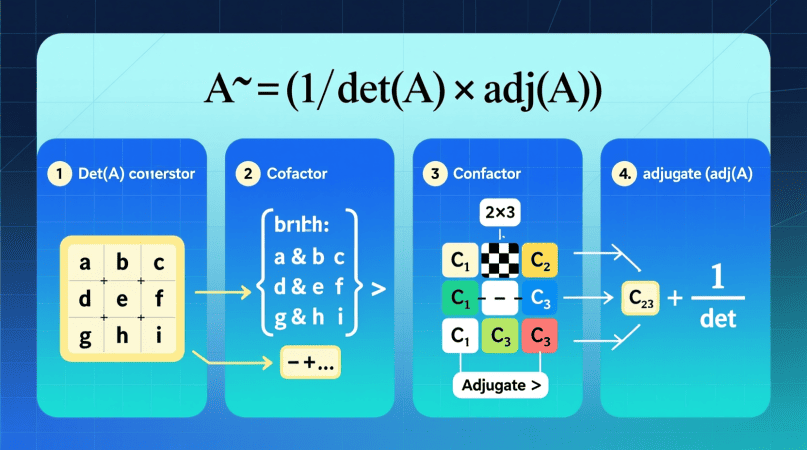
The general formula is: A−1=1det(A)⋅adj(A)A^{-1} = \frac{1}{\det(A)} \cdot \text{adj}(A)
- det(A)\det(A) = determinant of the matrix
- adj(A)\text{adj}(A) = transpose of the cofactor matrix
Step 1: Find the Determinant
For A=[abcdefghi]A = \begin{bmatrix} a & b & c \\ d & e & f \\ g & h & i \end{bmatrix} det(A)=a(ei−fh)−b(di−fg)+c(dh−eg)\det(A) = a(ei – fh) – b(di – fg) + c(dh – eg)
Step 2: Compute Minors and Cofactors
- The minor of each entry is the determinant of the 2×2 matrix left after removing its row and column.
- Apply the checkerboard sign pattern:
[+−+−+−+−+]\begin{bmatrix} + & – & + \\ – & + & – \\ + & – & + \end{bmatrix}
to get the cofactor matrix.
Step 3: Take the Transpose
Transpose the cofactor matrix → this gives the adjugate.
Step 4: Multiply by 1/det(A)1/\det(A)
Divide every entry of the adjugate matrix by the determinant.
Worked Example
Let A=[123014560]A = \begin{bmatrix} 1 & 2 & 3 \\ 0 & 1 & 4 \\ 5 & 6 & 0 \end{bmatrix}
Determinant: det(A)=1(1⋅0−4⋅6)−2(0⋅0−4⋅5)+3(0⋅6−1⋅5)=−24+40−15=1\det(A) = 1(1\cdot 0 – 4\cdot 6) – 2(0\cdot 0 – 4\cdot 5) + 3(0\cdot 6 – 1\cdot 5) = -24 + 40 – 15 = 1
Since det(A)=1\det(A) = 1, the matrix is invertible.
Cofactor matrix: [−2420−518−1545−41]\begin{bmatrix} -24 & 20 & -5 \\ 18 & -15 & 4 \\ 5 & -4 & 1 \end{bmatrix}
Adjugate (transpose): adj(A)=[−2418520−15−4−541]\text{adj}(A) = \begin{bmatrix} -24 & 18 & 5 \\ 20 & -15 & -4 \\ -5 & 4 & 1 \end{bmatrix}
Inverse: A−1=11×adj(A)=[−2418520−15−4−541]A^{-1} = \frac{1}{1} \times \text{adj}(A) = \begin{bmatrix} -24 & 18 & 5 \\ 20 & -15 & -4 \\ -5 & 4 & 1 \end{bmatrix}
Method 2: Row Operations (Gauss–Jordan)
Another way to invert a 3×3 matrix is by row operations:
- Write the augmented matrix [A∣I][A | I].
- Perform row operations to turn the left side into the identity matrix.
- The right side becomes A−1A^{-1}.
This method is slower by hand but scales well and is what most algorithms use.
Using Software and Calculators
For larger or messy numbers, use tools to avoid arithmetic mistakes.
- Python (NumPy):
import numpy as np A = np.array([[1,2,3],[0,1,4],[5,6,0]]) print(np.linalg.inv(A)) - MATLAB / Octave:
inv(A) - Excel / Google Sheets:
=MINVERSE(A1:C3) - Online tool: Try this inverse matrix calculator for instant results with step-by-step solutions.
Common Mistakes to Watch Out For
- Miscalculating the determinant.
- Forgetting to apply the sign pattern when computing cofactors.
- Not transposing the cofactor matrix.
- Dividing by zero when the determinant = 0.
- Arithmetic slips with fractions or decimals.
Quick Comparison of Methods
| Method | Best For | Pros | Cons |
|---|---|---|---|
| Adjugate / Formula | Learning theory, clean numbers | Systematic, builds understanding | Tedious with messy entries |
| Row Operations | Larger matrices, teaching row reduction | Works for any size, consistent | Many steps, prone to error |
| Software / Calculator | Practical use, real-world problems | Fast, accurate | Requires tools |
FAQs
Q: What is the formula for the inverse of a 3×3 matrix?
A: A−1=1det(A) adj(A)A^{-1} = \frac{1}{\det(A)} \, \text{adj}(A).
Q: When does a 3×3 matrix have no inverse?
A: If the determinant is 0, the matrix is singular and cannot be inverted.
Q: How do I check my inverse is correct?
A: Multiply A×A−1A \times A^{-1}; it should return the identity matrix.
Q: Can I use decimals or fractions in the formula?
A: Yes, the formula works with any real numbers, but be careful with rounding.
Q: How do I invert a 3×3 matrix in Python?
A: Use numpy.linalg.inv() in NumPy.
- Beginners should try calculating 2×2 inverses before tackling this dimension.
- A crucial part of this process involves using the determinant to check for singularity.
- You can verify your manual answers by using a scientific calculator to check the result.
- If you need to solve larger systems, the steps for calculating 4×4 matrices are quite similar.
- Students often find it faster to solve these in Excel when dealing with homework.
- For a quicker check on specific devices, see our guide on the 3×3 calculator method.
- Review the general definition of a matrix inverse to understand the mathematical properties.
John H. Cleveland is the creator of Inversematrixcalculator.com, a trusted resource dedicated to providing accurate and easy-to-use matrix calculation tools. With a strong background in mathematics and a passion for simplifying complex concepts, John focuses on delivering clear, reliable solutions for students, educators, and professionals. His goal is to help users save time and confidently solve matrix problems with precision.